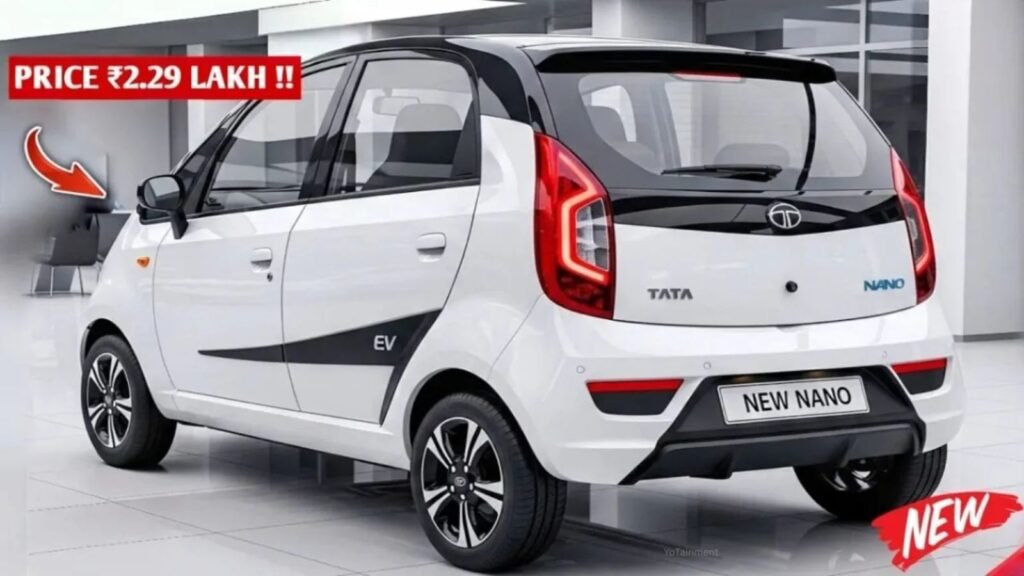
Few car names in India carry the emotional weight and instant recognition of the Nano. It was once introduced as a revolutionary idea—mobility for the masses at an unprecedented price point. Now, years after production ended, conversations are once again building around a possible comeback, this time in the form of the Tata Nano New Model 2026. But unlike the original chapter, the narrative surrounding the Tata Nano New Model 2026 is far more mature, strategic, and aligned with modern urban realities.

Today’s buyers are not simply looking for the cheapest car available. They want value, efficiency, safety, technology, and a sense of pride in ownership. Rising fuel prices, increasingly congested cities, and the growing shift toward electrification have created the perfect backdrop for a reimagined Nano. If industry speculation proves accurate, the Tata Nano New Model 2026 could return not as a compromise, but as a smart solution for urban mobility.
The timing feels right. Tata Motors has dramatically transformed its brand image over the last few years. Known now for safety-focused engineering, bold design language, and reliable products, Tata is in a stronger position than ever. In that context, the Tata Nano New Model 2026 does not feel like nostalgia—it feels like unfinished business, done properly this time.
Why the Tata Nano’s Return Matters More Than Ever
The entry-level car market in India has evolved quietly but significantly. Two-wheelers still dominate in sheer numbers, yet many families aspire to upgrade to something safer and more comfortable. However, with entry-level hatchbacks becoming increasingly expensive, the gap between two-wheelers and cars has widened. This is precisely where the Tata Nano New Model 2026 could play a transformative role.
For first-time buyers, affordability remains crucial—but not at the cost of dignity or safety. The earlier Nano struggled partly because it was perceived purely as the “cheapest car.” The Tata Nano New Model 2026 is expected to avoid that trap entirely. Instead of focusing solely on price, it is likely to position itself as a practical, efficient, and intelligent city companion.
There’s also the broader shift toward electrification. Smaller cars make tremendous sense in the EV space because lighter vehicles require smaller batteries, which help reduce costs. The compact footprint of the Tata Nano New Model 2026 gives Tata Motors a genuine opportunity to introduce one of the most accessible electric cars in the country. As cities tighten emission norms and fuel prices remain unpredictable, a compact urban vehicle like the Tata Nano New Model 2026 could become extremely relevant.
Additionally, Tata’s improved reputation strengthens the potential success of the Tata Nano New Model 2026. Consumers now associate the brand with strong build quality and better crash safety standards. That trust factor could significantly reshape how buyers perceive this revival.
A Fresh Design Philosophy for a Modern Era
From Basic to Bold
One of the most anticipated changes in the Tata Nano New Model 2026 will likely be its exterior design. The original Nano was functional, but it lacked aspiration. The new version is expected to look entirely different—modern, youthful, and in line with Tata’s current design identity.
The Tata Nano New Model 2026 could feature sleeker headlamps, possibly with LED daytime running lights in higher variants. A sculpted front bumper and a cleaner grille design may give it a confident, premium feel despite its compact proportions. Instead of appearing tiny and utilitarian, the Tata Nano New Model 2026 is expected to look purposeful and stylish.
Stronger character lines along the side profile could enhance visual appeal, while better wheel designs might give the Tata Nano New Model 2026 a more planted stance. Even subtle improvements in proportions—like a slightly wider track or revised roofline—could dramatically improve its road presence.
At the rear, redesigned tail lamps and a sharper tailgate layout could complete the transformation. The goal seems clear: ensure that the Tata Nano New Model 2026 feels like a thoughtfully designed city hatchback rather than a budget experiment.
Cabin Experience: Compact Yet Surprisingly Comfortable
Smarter Use of Space
Step inside, and the expectations around the Tata Nano New Model 2026 become even more interesting. Tata Motors has significantly upgraded cabin quality across its lineup in recent years, and those lessons are likely to benefit the new Nano as well.
The Tata Nano New Model 2026 could offer improved seat cushioning, better upholstery materials, and a more ergonomic dashboard layout. Instead of a bare-bones interior, buyers may find a cabin that feels modern and thoughtfully arranged. Even small improvements—such as better door trims and smarter storage spaces—could make a noticeable difference in daily usability.
A touchscreen infotainment system is widely expected in higher trims of the Tata Nano New Model 2026, potentially offering Android Auto and Apple CarPlay connectivity. A semi-digital or fully digital instrument cluster may further modernize the driving experience. These features are no longer luxuries—they are expectations, even in entry-level vehicles.
Air-conditioning performance, always critical in Indian climates, will likely see improvement in the Tata Nano New Model 2026. For urban commuters spending long hours in traffic, comfort matters just as much as efficiency.
Despite its compact footprint, clever packaging could allow the Tata Nano New Model 2026 to provide adequate legroom for small families. Foldable rear seats may add practicality, making grocery runs and short trips more convenient.
Powertrain Options: Efficiency at the Core
Petrol Engine Refinement
When it comes to performance, the Tata Nano New Model 2026 is expected to prioritize efficiency over outright speed. A small-capacity petrol engine, likely refined for smoother performance and better fuel economy, could power the base variants.
Mileage will be a key selling point. If the Tata Nano New Model 2026 delivers fuel efficiency figures in the range of 25–30 kmpl, it would easily become one of the most economical cars in India. Low running costs could significantly boost its appeal among budget-conscious buyers.
An AMT (Automated Manual Transmission) option could also be introduced in the Tata Nano New Model 2026, especially considering how popular clutch-free driving has become in urban traffic conditions.
The Electric Possibility
The electric variant of the Tata Nano New Model 2026 could be the real game-changer. With a projected range of around 150–200 kilometers, an EV version would suit daily city commuting perfectly.
Because of its lightweight platform, the Tata Nano New Model 2026 EV could use a smaller battery pack, helping keep costs under control. Faster charging times and lower energy consumption would make it practical for city users who primarily drive short distances.
If Tata positions the electric Tata Nano New Model 2026 competitively, it could open EV ownership to an entirely new segment of buyers who previously found electric cars financially out of reach.
Safety: A Non-Negotiable Upgrade
Learning from the Past
Safety was one of the biggest criticisms of the original Nano. However, Tata Motors has since adopted a safety-first philosophy. The Tata Nano New Model 2026 is expected to reflect that shift clearly.
Dual airbags, ABS with EBD, rear parking sensors, and seatbelt reminders could come standard in the Tata Nano New Model 2026. Structural improvements and better crash protection would be essential to rebuild confidence.
For many families upgrading from two-wheelers, the Tata Nano New Model 2026 would represent their first car. Ensuring that it provides meaningful safety improvements could significantly influence purchase decisions.
By aligning with stricter safety norms, the Tata Nano New Model 2026 could redefine what buyers expect from affordable vehicles.
Pricing Strategy and Market Positioning
Affordable Yet Aspirational
Affordability remains central to the Nano story, but the Tata Nano New Model 2026 must balance price with value. Early expectations suggest petrol variants could start around ₹3.50 lakh, with higher trims reaching closer to ₹4.75 lakh.
The electric Tata Nano New Model 2026 might fall within the ₹5 lakh to ₹6.75 lakh range, depending on battery size and government incentives. If priced strategically, it could become one of the most accessible EVs in India.
Such pricing would place the Tata Nano New Model 2026 in a unique position. It wouldn’t directly challenge premium hatchbacks but would attract buyers who feel priced out of the mainstream entry-level segment.
Fleet operators, last-mile mobility providers, and urban commuters could also see practical value in the Tata Nano New Model 2026, especially the EV version.
Who Is the Tata Nano New Model 2026 Designed For?
The Tata Nano New Model 2026 appears targeted squarely at urban India. Students, young professionals, small families, and individuals seeking a second car for city duties could all find it appealing.
In crowded metropolitan areas, where parking space is limited and traffic congestion is routine, the compact dimensions of the Tata Nano New Model 2026 would become a major advantage.
For environmentally conscious buyers, the electric Tata Nano New Model 2026 could offer an affordable step into sustainable mobility without the premium pricing usually associated with EVs.
More importantly, the Tata Nano New Model 2026 could help normalize the idea that small cars can be stylish, technologically equipped, and genuinely safe.
Final Outlook: A Comeback with Purpose
The Nano has always held a special place in India’s automotive history. With the Tata Nano New Model 2026, Tata Motors has the opportunity to rewrite that story entirely.
This time, the focus is not just on affordability. It is on relevance. By combining modern design, improved safety, enhanced features, and strong efficiency, the Tata Nano New Model 2026 could redefine urban mobility for a new generation.
If executed thoughtfully, the Tata Nano New Model 2026 will not merely revive a nameplate—it could reshape the conversation around affordable cars in India. Instead of being remembered as an ambitious experiment, the Tata Nano New Model 2026 could finally become what it was always meant to be: a smart, practical, and respected solution for everyday driving.